One of the many definitions of the golden ratio φ = 1.61803... is the unique number such that a φ-by-1 golden rectangle can be decomposed into a 1-by-1 square and a smaller 1-by-(φ−1) golden rectangle.
To create the golden rectangle fractal, repeat the process of (1) replacing each golden rectangle with a square and a smaller golden rectangle, and (2) replacing each square with four smaller golden rectangles, leaving a square hole:
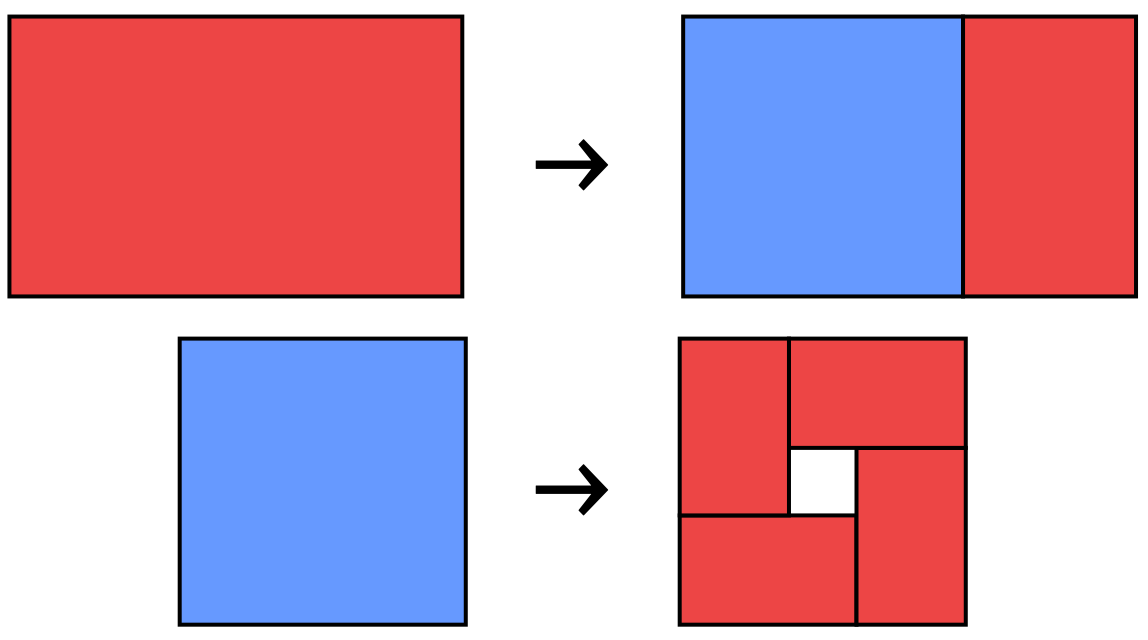
Alternating the application of these two rules on an initial golden rectangle results in approximations to the golden rectangle fractal:
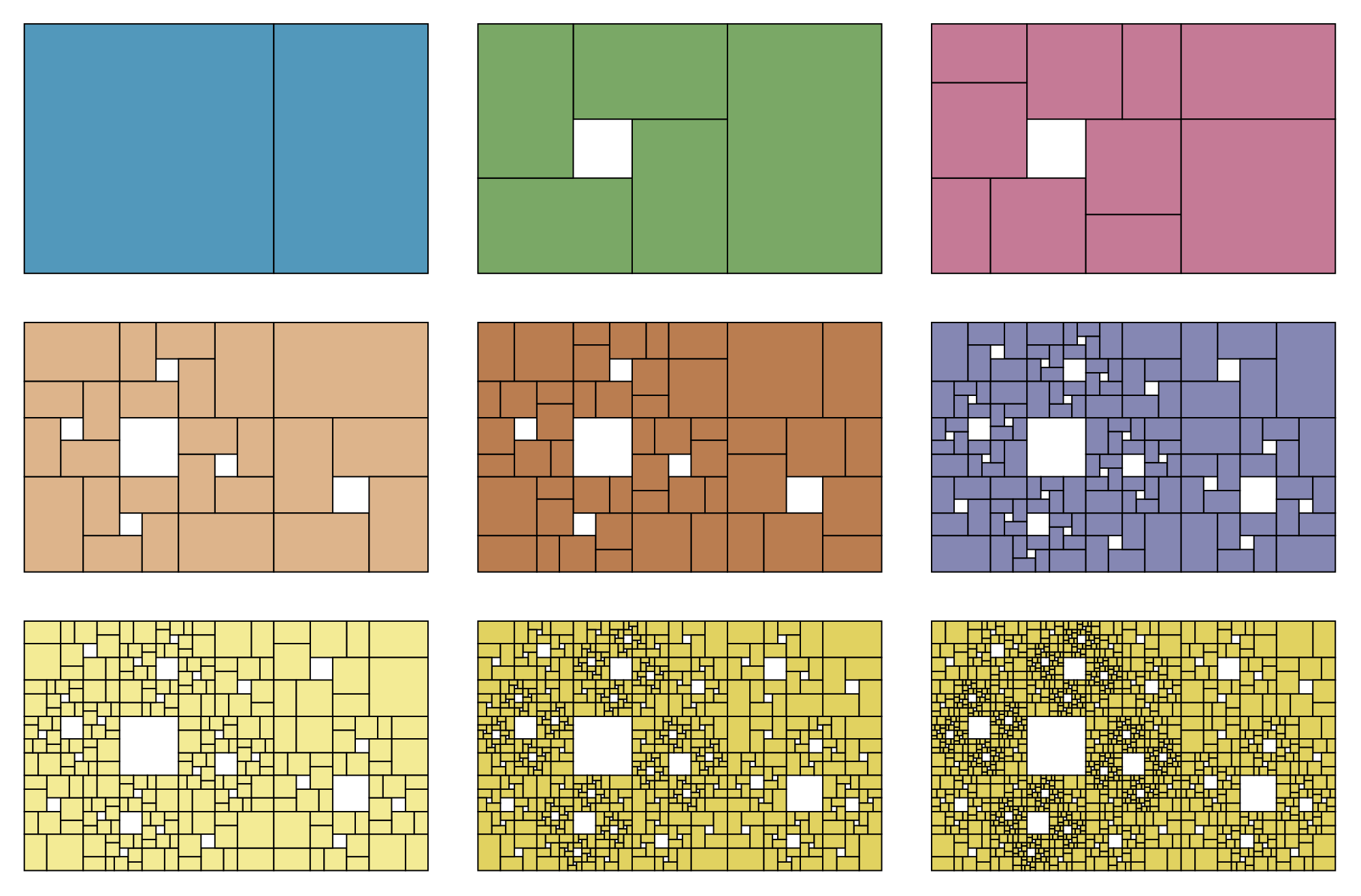
This decomposition also kind of figures into the Fibonacci spiral and continued fraction representations of ratios of successive Fibonacci numbers.
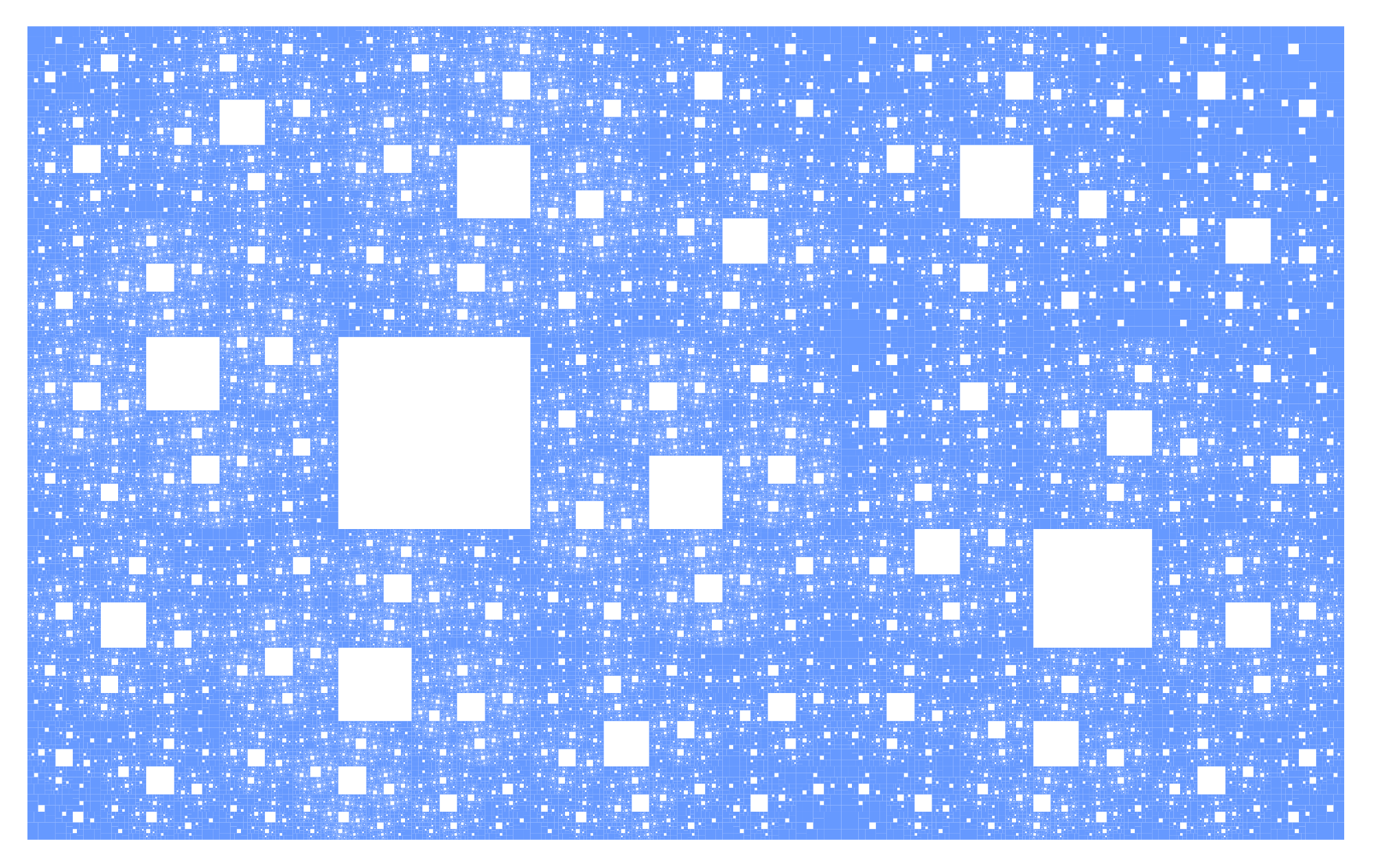
After a few more iterations:
Coloring each square or rectangle by the number of iterations/divisions it’s undergone:
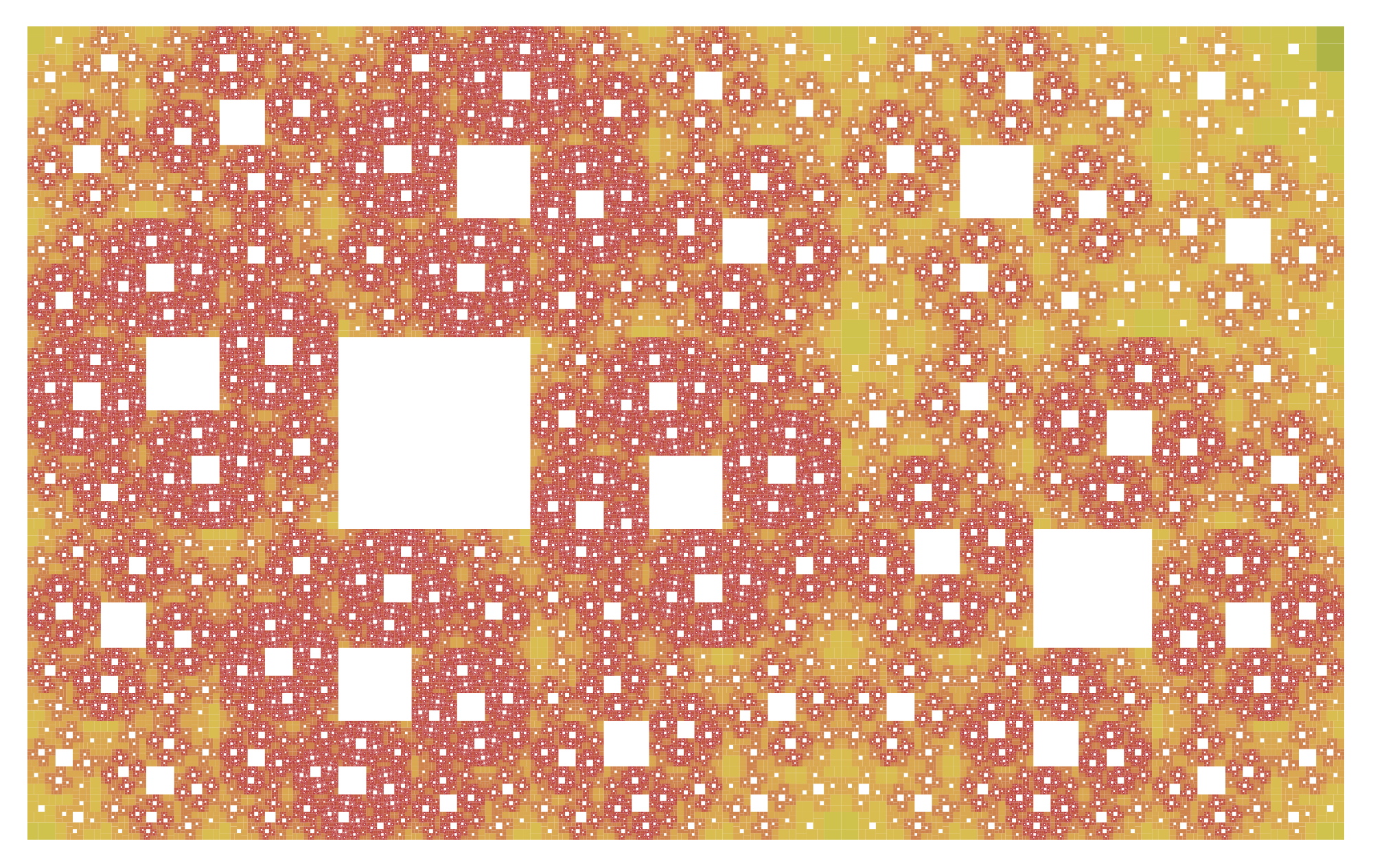
(Taking the initial figure with one square and one rectangle as iteration zero, application of the first rule — square to rectangles — results in 5(n+1)/2 rectangles for odd n, and application of the second rule — rectangle to a square and a rectangle — results in 5n/2 rectangles and 5n/2 squares, not counting the square holes, for even n.)
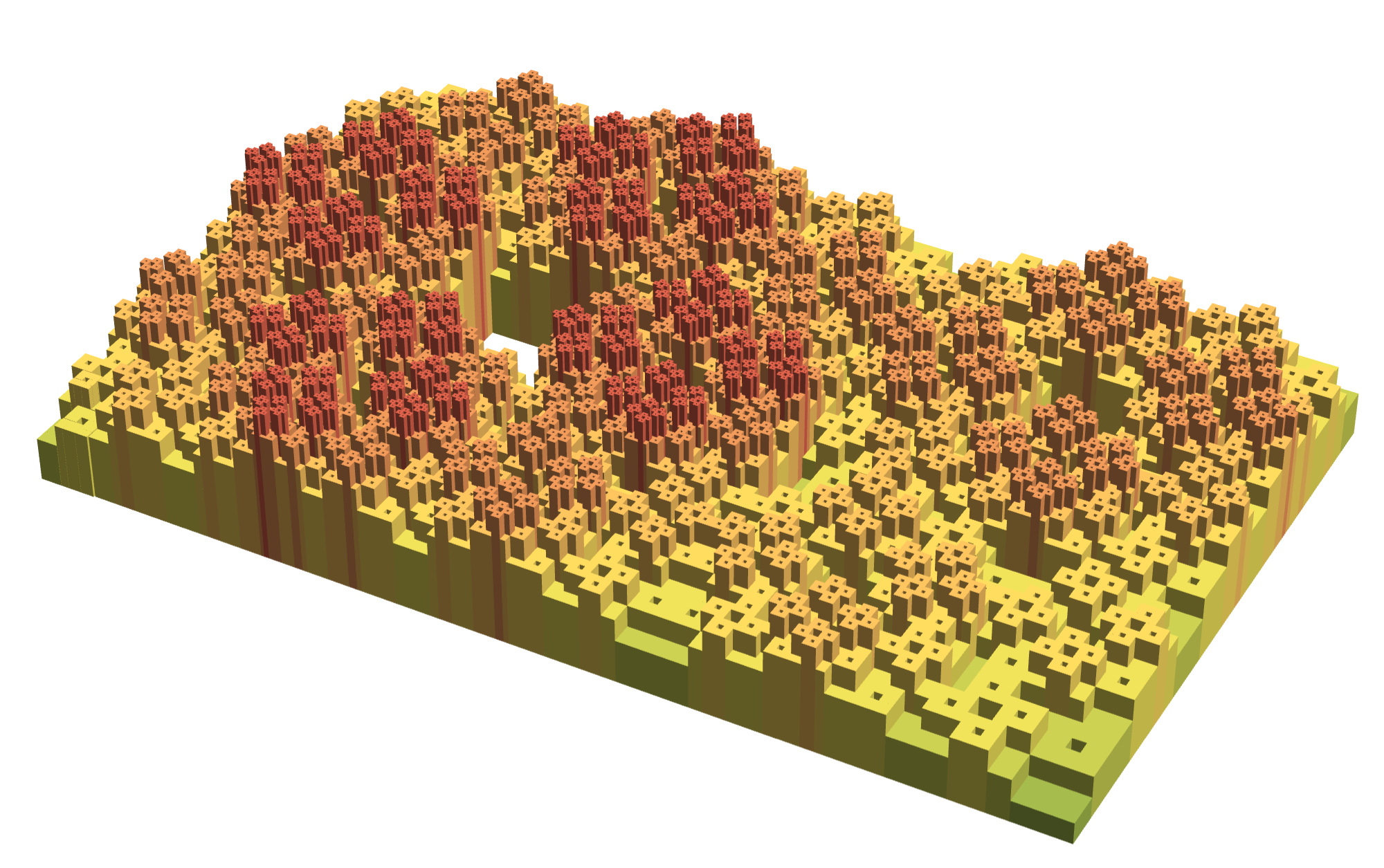
Same, but 3D-ified, heights based on number of iterations:
See Mark McClure’s Golden rectangle fractals page, with more exposition and a somewhat different iteration process. (The square parts of the decompositions here are rotationally symmetric, unlike the figures over there, for example.)
Designed and rendered using Mathematica 15.
© 2026 by Robert Dickau.
[ home ] || [ 2026-08-06 ]